Most first-time designer sneaker decisions start in the wrong place. The research goes: brand reputation, then price, then maybe a few Reddit threads. The shoe arrives, it looks right in photos, and then two weeks in something feels off. The toe is too long for your jeans, or the leather goes chalky in the crease, or the sole peels at the edge.
Honestly, all three of those are preventable. The decision that stops them is made before you pick the brand — it's the last and the leather finish.
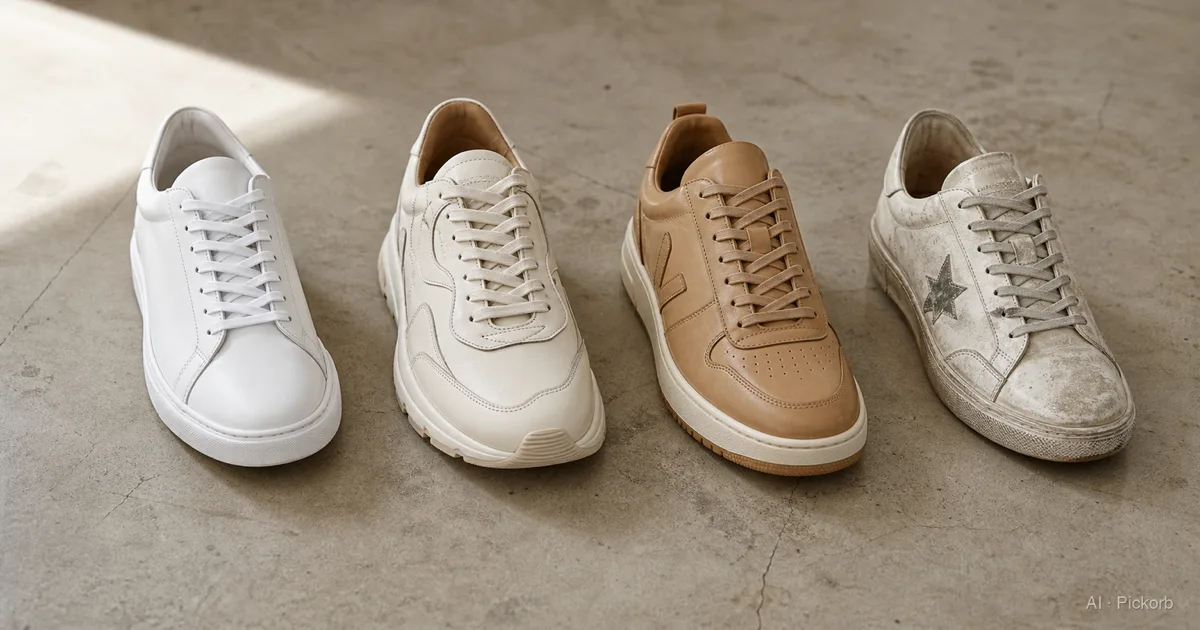
At USD 300–500, the price spread across Common Projects, Premiata, Veja, and Golden Goose is real but not dramatic. What's actually different is the shape of the shoe on your foot and how the leather behaves over a year. Get those two right, and the brand follows naturally.
The last is the decision most people skip
A last is the three-dimensional form a shoe is built around. It determines the toe shape, instep height, and how the ball of your foot sits inside the shoe (Cordwainers College at London College of Fashion). Two sneakers at the same size in different lasts will fit completely differently.
Common Projects builds its Achilles line on a modern minimal last: a long, narrow toe that reads sleek in a straight profile view (Common Projects). It pairs naturally with slim-cut denim and tapered trousers. The same narrowness means anyone with a wide forefoot will feel pressure across the metatarsals from the first wear. There's no break-in that fixes this — it's a shape issue, not a stiffness issue.
Premiata's Italian sneaker last is more sculpted and slightly wider across the toe box (Premiata). The profile reads contemporary without being aggressively minimal. If you've been wearing wider-lasted shoes — classic leather loafers, traditional runners — the Premiata last will feel familiar on foot. If you're coming straight from Nike or Adidas, Common Projects' narrow last will feel like a bigger shift than the price tag suggests.
Veja works with a rounder, more functional last with extra room in the forefoot (Veja). It's the most neutral of the four — closest to a standard athletic last, which is why Veja tends to fit the broadest range of foot shapes without issue. The trade-off is that it reads less directional in silhouette.
Golden Goose uses an Italian sneaker last with a standard-to-slightly-narrow fit (Golden Goose). The distressed construction is added on top, so the underlying last behaviour is more conventional than the aesthetic suggests.
One useful test before buying: if you already own Italian leather loafers that fit well, Premiata will likely translate. If your reference point is slim European running shoes, Common Projects is closer. If neither applies, start with Veja.
Leather grade and what it does after a year
The leather on a designer sneaker in this price range is almost always full grain or corrected grain bovine upper. The difference between the two determines whether the shoe ages well or starts looking worn in the wrong way.
Full grain leather (Leather Working Group) keeps the top surface of the hide intact. It's denser, resists moisture better, and develops a patina — the gradual darkening and character-building that happens after months of wear. Common Projects' Achilles in smooth calf is full grain. Premiata's main leather runners use full grain on most colourways. Full grain looks rough in the first two weeks — small scuffs and creases appear fast — and then the surface begins to consolidate. After six months, the shoe looks lived-in in a way that reads intentional.
Corrected grain leather has the surface buffed and an embossed grain applied. It looks more uniform out of the box, holds its appearance longer early on, and then starts to wear unevenly — the coating separates from the hide in high-flex areas like the toe crease and behind the ankle. This is common on entry-level colourways across several brands and isn't always obvious from product photos. As a rough rule: if the leather surface looks completely flawless and uniform in the product shot, it's likely corrected.
Nubuck and suede behave differently again. Nubuck is buffed from the grain side, suede from the flesh side. Both absorb moisture quickly and need a spray protector before first wear. Veja's suede colourways and some Premiata runners come in nubuck — worth knowing if your city gets frequent rain.
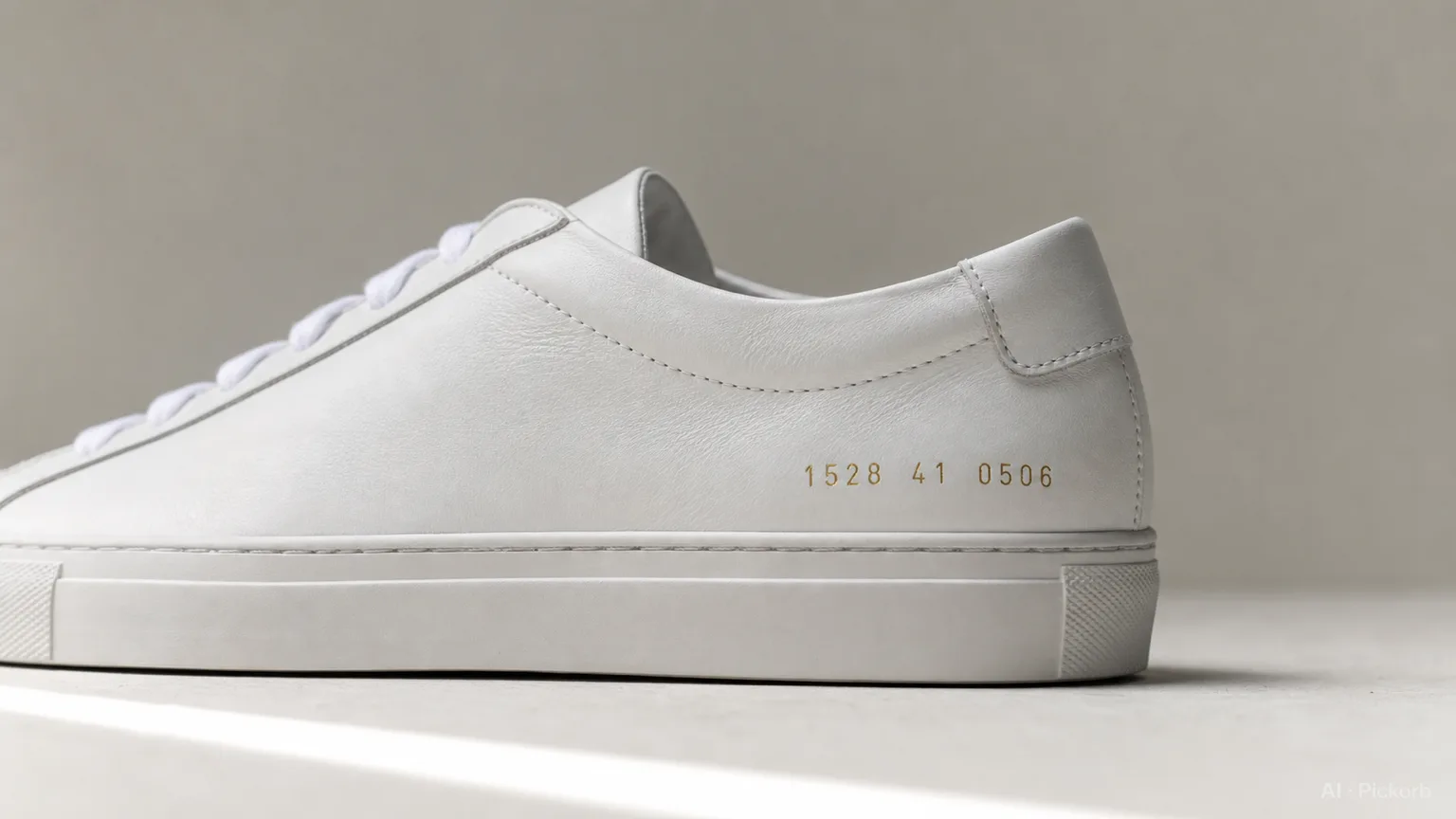
Common Projects, the minimal last and what it asks of your wardrobe
Common Projects' design is spare to an unusual degree. The most visible element on the Achilles is the gold foil serial number stamped on the lateral heel — no logo, no stitching pattern, no colour blocking (Common Projects). The sole edge is vulcanised rubber running flush with the upper, which keeps the silhouette flat and ground-level from every angle.
That minimalism works best when everything else in the outfit is equally considered. Slim dark denim, a clean Oxford shirt or crew-neck knit — the shoe reads as the punctuation mark. In a looser, more layered outfit, the minimal last can disappear or read as underwhelming next to busier garments.
The sole construction matters practically. Vulcanised rubber means the upper and sole are bonded with heat and adhesive, not stitched — sole replacement is essentially impossible without destroying the shoe (Society of Master Saddlers). Buy this shoe if you're prepared to wear it until the sole is through, or to treat the upper as the long-term investment and accept the sole as consumable.
The serial number is a small thing that changes how you relate to the shoe. Every Achilles has a production number. Long-time owners describe it as the detail that makes the shoe feel specific to them rather than generic.
Premiata, the Italian last and sculptural construction
Premiata has been making shoes in the Marche region of Italy since 1885 (Premiata), and the sneaker lines carry the construction vocabulary of that background. Leather upper on a last with genuine instep and heel structure, sole units that are more built-up than a flat vulcanised profile.
The result is a sneaker that feels more substantial on foot than Common Projects. Not heavier in a burdensome way — more like the shoe has architecture. The toe box has room, the ankle collar has structure, and the sole unit has visible layering. A Premiata runner reads clearly as a sneaker; it doesn't try to flatten into a silhouette the way Common Projects does.
This makes Premiata the easier starting point for a wardrobe that includes casual tailoring — chinos, an unstructured blazer, relaxed-cut trousers. The shoe has enough visual substance to hold its own next to structured garments, where the Common Projects minimal last can read as too thin.
Colour selection follows a different logic too. Common Projects' canonical choice is white — the serial number reads cleanest on a white canvas. Premiata's palette runs darker across most seasons, with tonal leathers and multi-material combinations that age more forgivingly under daily wear.
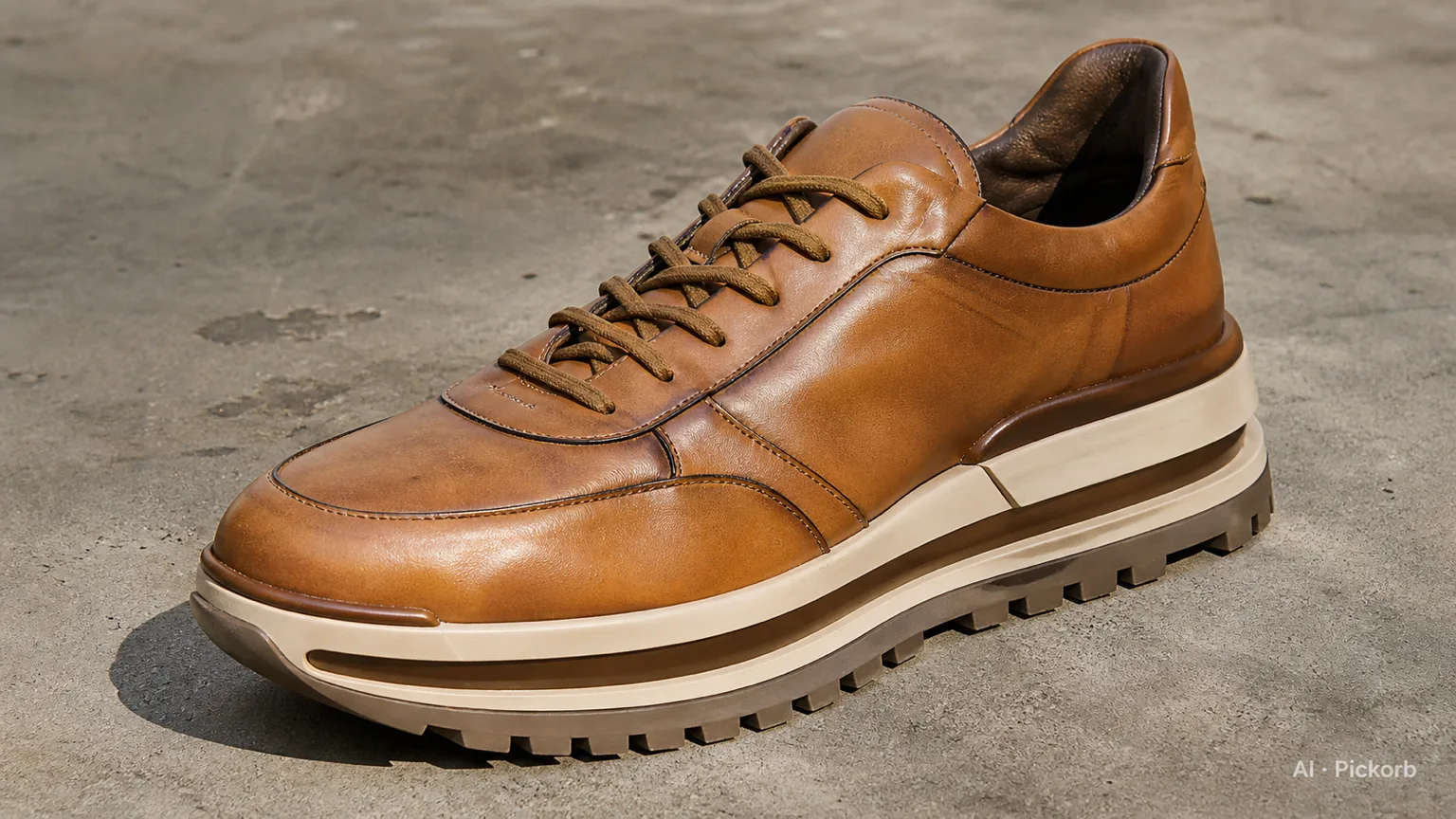
Veja, the conscious last and what the V logo commits you to
Veja communicates its sourcing and manufacturing standards more explicitly than the other three brands here (Veja). The rubber sole is wild-harvested from the Amazon, the leather is traceable to farms certified by the Brazilian Leather Centre, and the factories in Brazil are paid above local minimum wage. This information is public and verifiable on Veja's own transparency pages.
What this means for the shoe on your foot: the materials behave a little differently. The wild rubber sole is slightly softer underfoot than a standard synthetic compound — some wearers notice this as more cushion, others as slightly less snap-back under the ball of the foot. The Amazonian rubber also wears a little faster on hard urban surfaces. That's a real trade-off, not a defect.
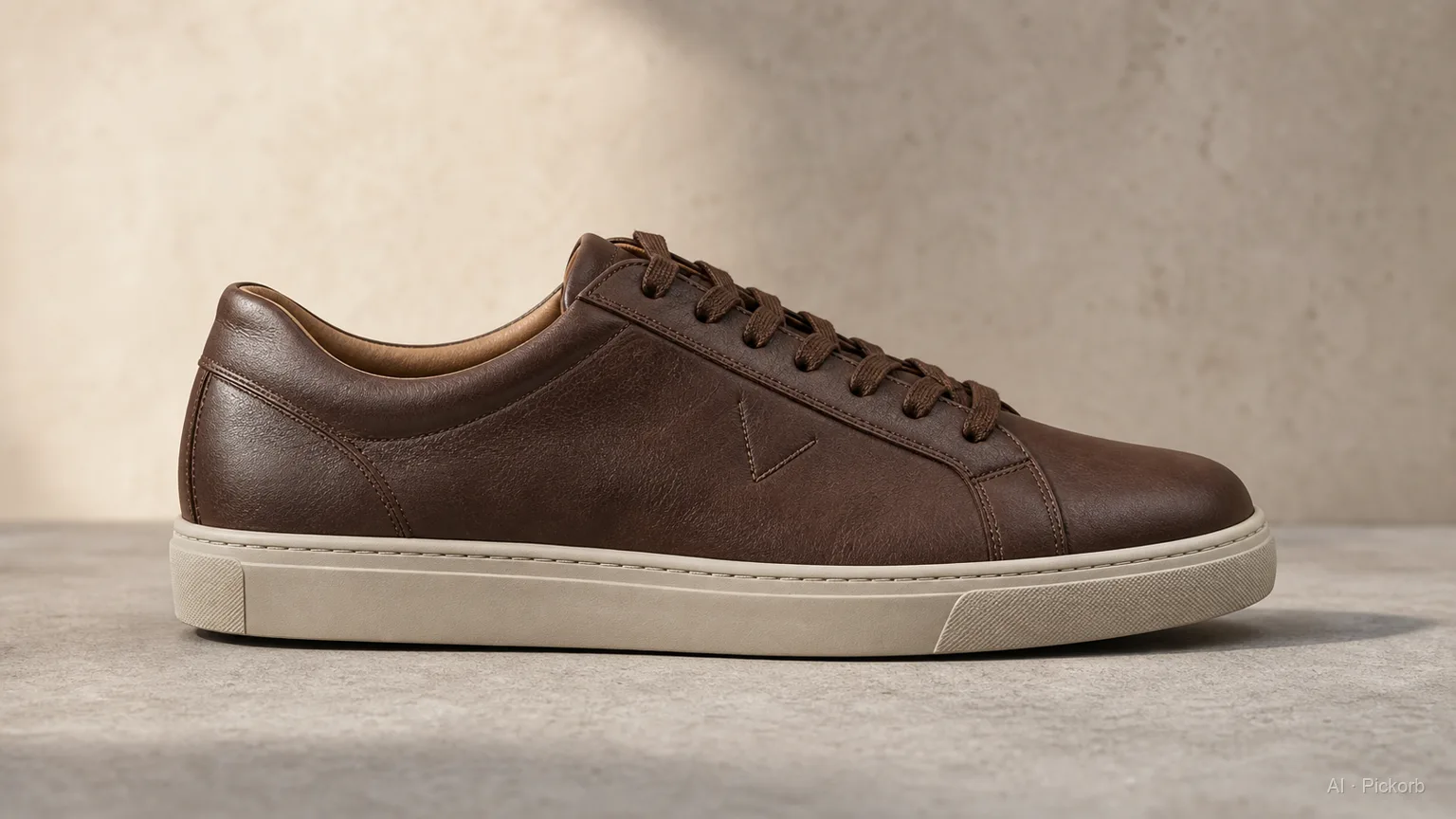
The V logo on the lateral is the most visible design element, larger and more graphic than the serial number on Common Projects or the hardware on Premiata. It reads clearly as Veja from a distance, which suits a wardrobe where the brand identity of footwear is meant to be readable. If your preference runs toward minimal visual noise, the V is a bigger commitment than it might look in photos.
The round, roomier last makes Veja the most versatile fit in this group. If Common Projects' narrow last is a concern, Veja is the nearest alternative at a similar price point with equivalent construction quality.
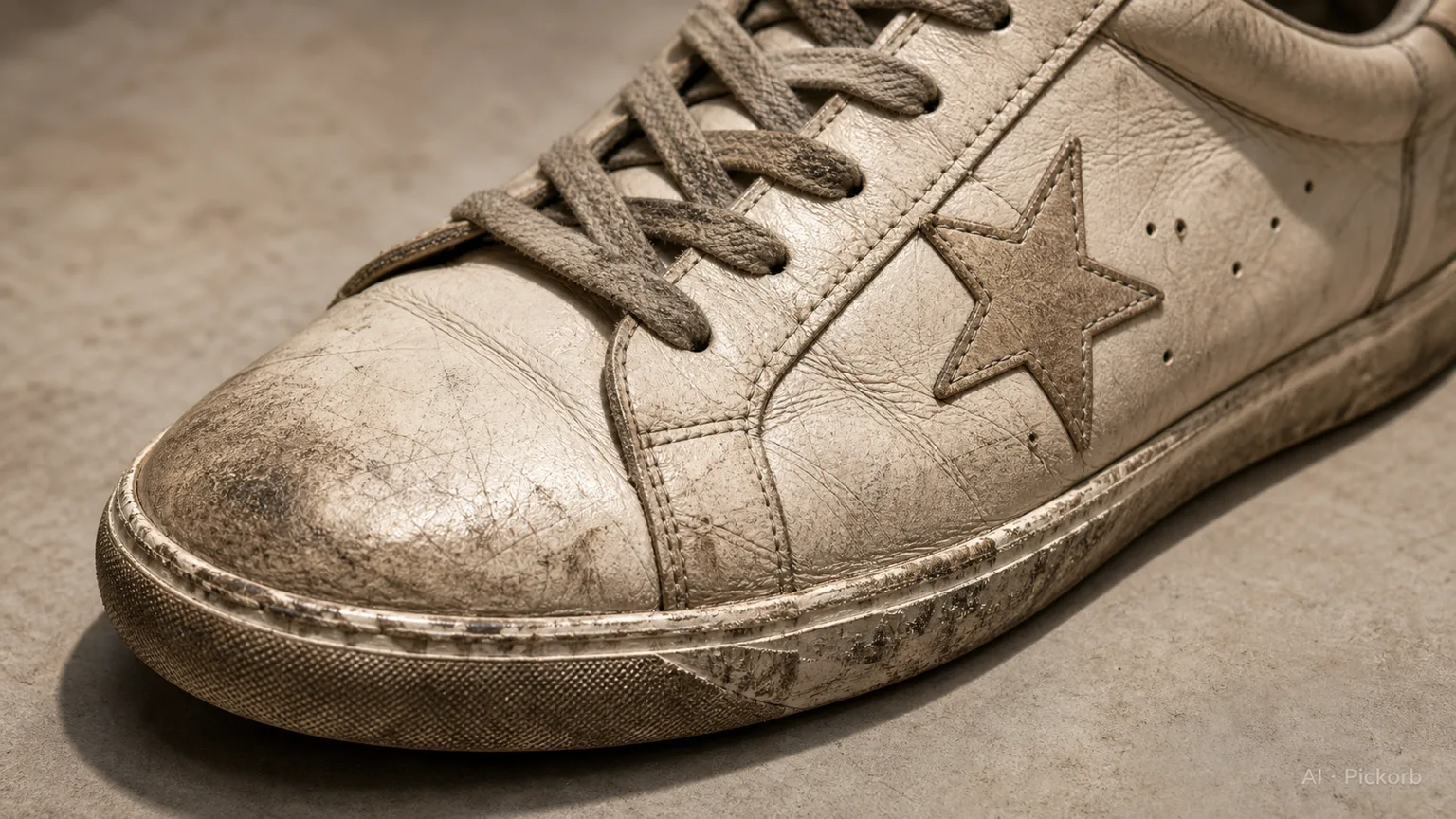
Golden Goose, the distressed finish and what it covers
Golden Goose's visual signature is intentional distress — scuff marks, worn edges, and faded finishes applied at the factory before the shoe ships (Golden Goose). The star logo sits on the lateral ankle panel and is the clearest brand identifier across all colourways.
The distressed finish is worth understanding structurally. The underlying shoe is a conventional Italian sneaker on a standard-to-slightly-narrow last, built with leather uppers and a cupsole construction. The distress is applied to the leather surface and the sole edge. This means the shoe starts in an already-aged-looking state — the awkward first-wear "too clean" phase is removed, but it also means you're purchasing a shoe with a predetermined aesthetic rather than one that develops over time.
Whether this is a feature or a trade-off depends on what you want from patina. Common Projects and Premiata full grain leathers will develop character with your wear — the scuffs and creases are yours. Golden Goose arrives with someone else's scuffs, evenly distributed. Some wearers find this liberating. Others find it removes the reason to invest in the material.
The cupsole construction is more repairable than a vulcanised flat sole, but the distressed leather finish is not restorable once it wears beyond the factory application. Plan to replace rather than restore.
Wardrobe starting points and which shoe fits first
The cleanest way to decide is to start from what you already wear most, not from the brand you've heard most about.
Slim denim and clean knitwear. Common Projects' minimal last keeps the proportions tight and the white Achilles reads as the focal detail without adding visual weight. This is the most common first-designer-sneaker combination and the reason Common Projects built a following here.
Casual tailoring — chinos, unstructured blazers, relaxed suit trousers. Premiata's sculpted last has enough visual weight to sit alongside structured garments. The Common Projects last can read as too thin here.
Mixed casual — cargo trousers, oversized tees, relaxed-fit denim. Golden Goose's distressed aesthetic handles the relaxed silhouette without looking incongruous. The visual noise of the distressing actually reads quieter against louder garments.
Functional daily wardrobe — varied fits, weather variable. Veja's round last and weather-tolerant rubber sole handle the widest range of contexts. If one pair has to do everything, Veja's versatility is genuinely practical.
Workout-adjacent wardrobe transitioning to dressier. Any of these four will feel like a shift from athletic footwear, but Premiata and Veja will feel less foreign underfoot than Common Projects' flat vulcanised sole, which has almost no cushion by running-shoe standards.
Sole types and the city wear question
Vulcanised rubber sole (Common Projects classic) bonds the sole to the upper with heat and pressure. It produces a very flat, ground-level profile that photographs well and reads minimal. The bond can separate at the toe with frequent flex in wet conditions, and the sole cannot be replaced without damaging the upper. If you walk 5km+ daily on hard pavement, this construction wears faster than the alternatives.
Cup sole (Golden Goose, many Premiata models) wraps a pre-formed rubber unit around the lower edge of the upper. More durable underfoot, easier to resole with a cobbler, and better wet grip because the outsole compound can be chosen independently of the upper construction.
Commando or lug sole (available on some Premiata and Veja variants) adds tread depth, which improves grip significantly on wet stone and tile. The visual weight increases — not a silhouette-neutral choice — but for winter city wear, the grip difference is practical.
One direct comparison: in rain on polished marble or wet tile, a vulcanised smooth rubber sole has very little grip. The Common Projects Achilles in white on a wet museum floor is a known risk. Veja's wild rubber compound and Golden Goose's cup sole both perform better in wet conditions.
Sizing across four lasts
All four brands label in European sizing. The last differences mean identical labelled sizes fit differently.
Common Projects' narrow last runs close to true Italian sizing. If you're between European sizes, go up half. If you have a wide forefoot, going up half gives you length but not width — the last shape is the constraint.
Premiata's last accommodates a wider forefoot and runs slightly generous. True size or half-down is the common starting point, depending on foot width.
Veja runs slightly large. Half size down from your usual European size is the standard recommendation on most styles, though the V-10 and Campo run closer to true size.
Golden Goose runs true to European size on most styles. The cupsole construction gives enough volume inside that the fit is forgiving across a range of foot shapes.
If you're buying without trying on and your feet are in the narrow-to-standard range, your usual size works in all four. If you have a wide forefoot, Premiata and Veja are the lower-risk remote purchases.
Sources
- Common Projects — Achilles last and construction documentation
- Premiata — Marche heritage and current footwear construction
- Veja — sourcing transparency, rubber and leather supply chain
- Golden Goose — GGDB construction and sole documentation
- Leather Working Group — full grain vs corrected grain grading standards
- London College of Fashion — Cordwainers — last geometry and footwear construction reference
How this guide was built
This piece started from a recurring pattern: first-time designer sneaker buyers spend most of their research time comparing brand reputations, and often end up with a shoe whose last or leather finish doesn't quite work with their wardrobe. The structural information — last geometry, leather grain grades, sole construction — was cross-checked against each brand's official product pages (commonprojects.com, premiata.com, veja-store.com, goldengoose.com) and the Leather Working Group's public grading documentation. The wardrobe framing reflects the contemporary sneaker lineup Chexlow carries at this price point, so the recommendations stay within pieces a reader can actually evaluate.
Chexlow topic editor · AI illustration disclosed in image alt text